
The Combustion Master system from Rockwell Automation is a programmable controller-based combustion control system for use with single-or multi-burner gas and/or oil fired boilers. The pre-engineered Combustion Master system is capable of providing boiler firing rate control, fuel-to-air ratio, excess air trim, feed water and balanced draft control. In addition to the Combustion Master, Rockwell Automation offers a variety of Combustion Control Solutions for boilers burning alternate fuels such as pulverized or lump coal, RDF, process by-products such as liquids or gases, waste products and wood products.
The Rockwell Automation Integrated Architecture allows manufacturers to integrate their entire plant process, replacing isolated cells of activity with a single coordinated system that provides robust process control and improves the flow of information, from the simplest sensor on the plant floor to corporate intranet and extranet.
The Rockwell Automation Integrated Architecture improves user productivity and reduces total cost of ownership by providing unparalleled functionality, flexibility and scalability. Using sophisticated control, networking, visualization and information technologies, the Integrated Architecture addresses a full range of automation and information needs, including sequential, motion, process, drive and safety applications, and seamless information integration with the rest of the site, or the entire enterprise.
Real world security threats put the safety and operational integrity of Supervisory Control and Data Acquisition (SCADA) and other Industrial Control Systems (ICS) at risk. Ignoring security risks and discounting the need to protect against security threats may have far reaching consequences that extend beyond the value of the manufacturing equipment and proprietary information that comprises the system. These events can affect and disrupt health and safety, economic stability, national security and international security.
An energy management system (EMS) is a system of computer-aided tools used by operators of electric utility grids to monitor, control, and optimize the performance of the generation and/or transmission system.
The computer technology is also referred to as SCADA/EMS or EMS/SCADA. In these respects, the terminology EMS then excludes the monitoring and control functions, but more specifically refers to the collective suite of power network applications and to the generation control and scheduling applications.
Heating, ventilation and air conditioning (HVAC)[1] is the technology of indoor and vehicular environmental comfort. Its goal is to provide thermal comfort and acceptable indoor air quality. HVAC system design is a subdiscipline of mechanical engineering, based on the principles of thermodynamics, fluid mechanics, and heat transfer. Refrigeration is sometimes added to the field’s abbreviation as HVAC&R or HVACR, or ventilating is dropped as in HACR (such as the designation of HACR-rated circuit breakers).
HVAC is an important part of residential structures such as single family homes, apartment buildings, hotels and senior living facilities, medium to large industrial and office buildings such as skyscrapers and hospitals, onboard vessels, and in marine environments, where safe and healthy building conditions are regulated with respect to temperature and humidity, using fresh air from outdoors.
Ventilating or ventilation (the V in HVAC) is the process of exchanging or replacing air in any space to provide high indoor air quality which involves temperature control, oxygen replenishment, and removal of moisture, odors, smoke, heat, dust, airborne bacteria, carbon dioxide, and other gases. Ventilation removes unpleasant smells and excessive moisture, introduces outside air, keeps interior building air circulating, and prevents stagnation of the interior air
Wishtroop provides pulp makers with measurements, analyzers and a complete selection of state-of-the-art advanced process controls. Pulp makers can enjoy a feeling of control with just one mill-wide system covering all the pulp making processes from fiber line controls to baling information. Our customers all over the world can depend on our local Valmet service.
Process performance optimization solutions achieve a high level of stability in fiber and recovery line subprocesses. Optimizing the stability and throughput of subprocesses eliminates process bottlenecks and boosts capacity. Washing line optimization controls improve washing efficiency and reduce downstream bleaching chemical costs. In oxygen delignification and bleaching, you can reach significant chemical savings with Valmet process analyzers and optimization controls.
IQ quality control systems provide a comprehensive selection of on-line measurements, quality controls and profilers for pulp production processes.
The purpose of the drum level controller is to bring the drum up to level at boiler start-up and maintain the level at constant steam load.
A dramatic decrease in this level may uncover boiler tubes, allowing them to become overheated and damaged. An increase in this level may interfere with the process of separating moisture from steam within the drum, thus reducing boiler efficiency and carrying moisture into the process or turbine.
The functions of this control module can be broken down into the following:
- Operator adjustment of the setpoint for drum level
- Compensation for the shrink & swell effects
- Automatic control of drum level
- Manual control of the feedwater valve
- Bumpless transfer between auto and manual modes
- Indication of drum level and steam flow
- Indication of feedwater valve position and feedwater flow
- Absolute/deviation alarms for drum level
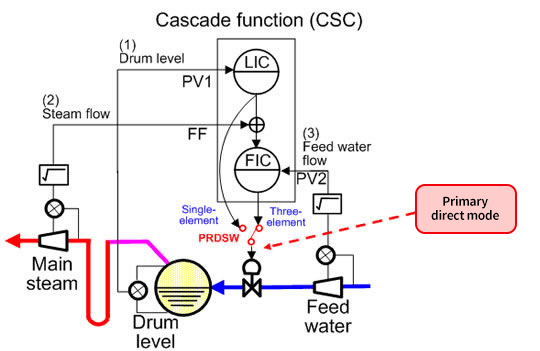
The three main options available for drum level control are
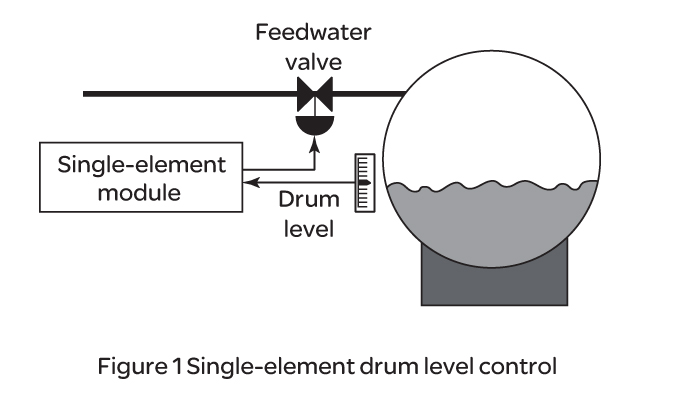
Single element drum level control
The simplest but least effective form of drum level control.
This consists of a proportional signal or process variable (PV) coming from the drum level transmitter. This signal is compared to a setpoint and the difference is a deviation value.
This signal is acted upon by the controller which generates corrective action in the form of a proportional output. The output is then passed to the boiler feedwater valve, which then adjusts the level of feedwater flow into the boiler drum.
Notes:
- Only one analogue input and one analogue output required
- Can only be applied to single boiler / single feedpump configurations with relatively stable loads since there is no relationship between drum level and steam- or feedwater flow
- Possible inadequate control option because of the swell effect
Two element drum level control
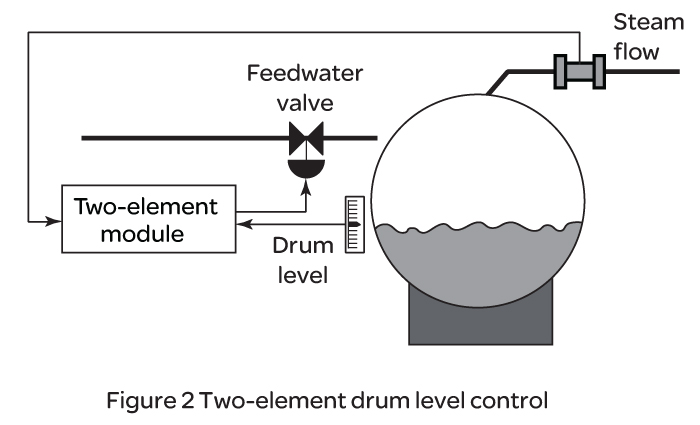
The two-element drum level controller can best be applied to a single drum boiler where the feedwater is at a constant pressure.The two elements are made up of the following:
Level Element: a proportional signal or process variable (PV) coming from the drum level transmitter. This signal is compared to a setpoint and the resultant is a deviation value. This signal is acted upon by the controller which generates corrective action in the form of a proportional value.
Steam Flow Element: a mass flow rate signal (corrected for density) is used to control the feedwater flow, giving immediate corrections to feedwater demand in response to load changes. Any imbalance between steam mass flow out and feedwater mass flow into the drum is corrected by the level controller. This imbalance can arise from
- Blowdown variations due to changes in dissolved solids
- Variations in feedwater supply pressure
- Leaks in the steam circuits
Notes:
- Tighter control of drum level than with only one element
- Steam flow acts as feed forward signal to allow faster level adjustments
- Can best be applied to single boiler / single feedpump configurations with a constant feedwater pressure
Three-element drum level control
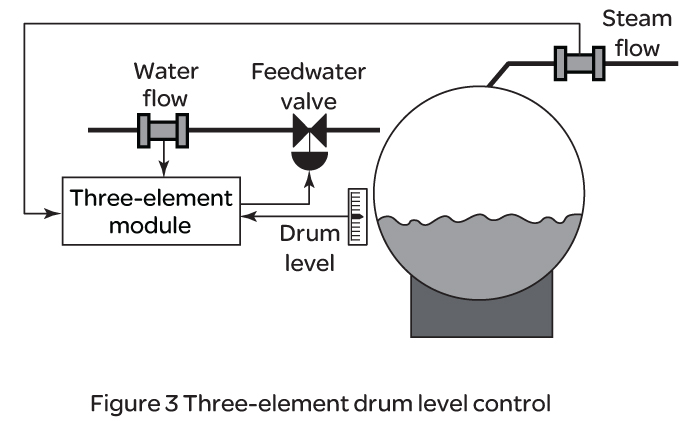
The three-element drum level control is ideally suited where a boiler plant consists of multiple boilers and multiple feedwater pumps or where the feedwater has variations in pressure or flow. The three-elements are made up of the following:
Level Element & Steam Flow Element: corrects for unmeasured disturbances within the system such as
- Boiler blowdown
- Boiler and superheater tube leaks
Feedwater Flow Element: responds rapidly to variations in feedwater demand, either from the
- Steam flow rate feedforward signal
- Feedwater pressure or flow fluctuations
In order to achieve optimum control, both steam and feedwater flow values should be corrected for density.
Notes:
- The three-element system provides tighter control for drum level with fluctuating steam load. Ideal where a system suffers from fluctuating feedwater pressure or flow
- More sophisticated level of control required
- Additional input for feedwater flow required
Enhanced three element drum level control
The enhanced three-element drum level control module incorporates the standard three element level components with the following improvements:
- The three-element mode is used during high steam demand. The two-element mode is used if the steam flow measurement fails and the module falls back to single element level control if the feedwater flow measurement should fail or if there is a low steam demand.
- The drum level can be derived from up to three independent transmitters and is density compensated for pressure within the boiler drum.
Notes:
- Tighter control through a choice of control schemes. Drum level maintained on failure of steam or feedwater flow measurements
- This module introduces an additional level control loop Boiler drum level control
This is an most ideal & economical system which allows flexibility of application and over all effeteness
Salient features :
- Substantial improvement in crush rate.
- Damage due to choking/jamming at can preparatory device & 1st mill is totally eliminated.
- Fluctuating demand of steam pressure due to irregular feed to the uniform cane feed predetermined rate result in optimum primary extraction.
- By substantial reduction of wear & tear, the down time reduces automatically and thus productivity improves.
- IIf eliminates the necessary of buffer resistors in cutter motors.
Specifications :
- Power supply : 230 volts A. C. / 50Hz
- Power Fuse : 1.5 Amps.
- Digital Display : 3 -1/2 digits
- Level display : LED type
- Over load indication : 24 – volt Lamp display.
- Facility : Set RPM and over load by counter dial.
- Field cable Connected with main unit.
- Control module : Connected with male & female connector